U.S. Buyer’s Guide for Transformers
Selecting the right transformer class—especially between distribution transformers, power transformers, and step-up transformers – can make or break a U.S. project. This guide gives EPC firms, developers, and industrial end users a practical framework to specify correctly, control losses and ensure grid compatibility. Distribution transformers → final MV→LV conversion (typ. 25–2500 kVA), ONAN/ONAF, OCTC. Power transformers → higher MVA at transmission/sub-transmission nodes, OLTC, ONAF/ODAF. Step-up transformers → generation side (PV/wind/genset/BESS), LV→MV; can fall into distribution or power class depending on rating.Quick Definitions
Distribution transformers
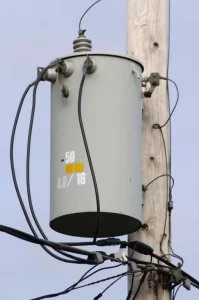
Reduce medium voltage (typical U.S. classes: 15/25/35 kV) to low voltage such as 480/277 V, 208/120 V or 400/415 V for local distribution. Most designs use ONAN cooling, OCTC tap changers and vector groups like Dyn11.Power transformers
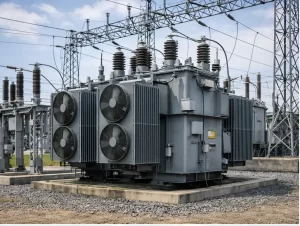
Handle higher MVA ratings at transmission or sub-transmission levels (e.g., 69 kV ↔ 13.8 kV). Commonly specified with OLTC, ONAF/ODAF cooling and stronger short-circuit performance.Step-up transformers
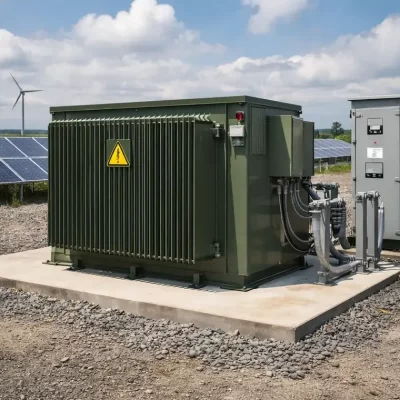
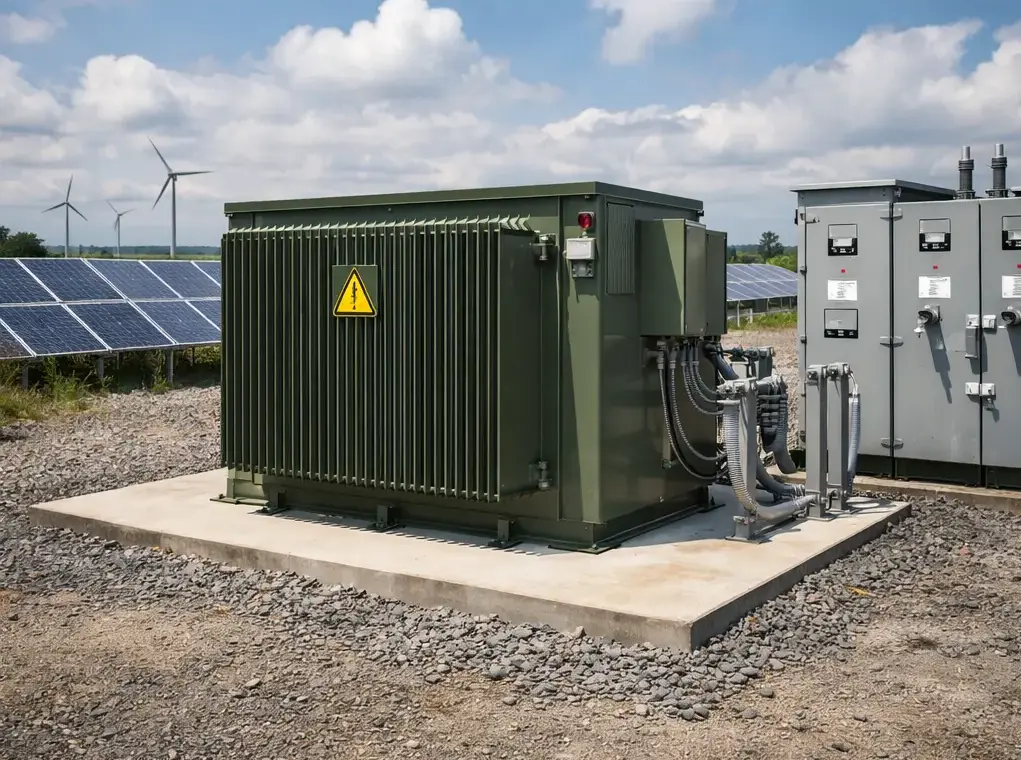
On the generation side (PV/wind/genset/BESS), raise LV such as 0.48–0.69 kV to MV like 15–35 kV. Depending on rating, a step-up unit may be engineered as a distribution or a power transformer.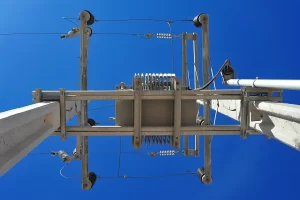
U.S. Context: Standards, Voltages and Efficiency
- Standards: Most U.S. utilities reference ANSI/IEEE C57. IEC 60076-based designs can be adapted to ANSI/IEEE requirements when specified.
- Typical MV classes: 15 kV, 25 kV, 35 kV (nominal systems 12.47/13.2/13.8 kV; 24.9/25 kV; 34.5 kV).
- LV outputs: 480/277 V (3-ph), 208/120 V, 600 V; many renewable and industrial sites use 0.4–0.69 kV secondary levels.
- Efficiency: DOE efficiency requirements apply to distribution class units. Confirm guaranteed no-load/load losses and tolerances.
Distribution vs Power vs Step-Up: Side-by-Side
| Criterion | Distribution Transformers | Power Transformers | Step-Up Transformers |
|---|---|---|---|
| Typical rating | 25-2500 kVA | 5-30+ MVA | 500 kVA → multi-MVA |
| Primary/Secondary | 15/25/35 kV → 0.48/0.415/0.4 kV | 69/115/138 kV ↔ 13.8/34.5 kV (examples) | 0.48-0.69 kV → 15-35 kV (PV/wind/genset) |
| Cooling | ONAN (ONAF optional) | ONAN / ONAF / ODAF | ONAN/ONAF; natural ester (FR3) optional |
| Tap-changer | OCTC (±2×2.5% common) | OLTC or OCTC | OCTC; OLTC in some projects |
| Typical use | Final distribution to loads | Transmission/sub-transmission interface | Generator step-up, interconnection |
Specifying for U.S. Projects: A Short Checklist
- Standard & tests: Confirm ANSI/IEEE C57 or IEC 60076; list routine tests (ratio/phase, impedance, losses, dielectric, etc.).
- Voltage & BIL: Match primary/secondary and BIL to utility requirements.
- Losses & efficiency: DOE compliance (where applicable); guaranteed losses and tolerances.
- Cooling & sound: Select ONAN/ONAF/ODAF based on load profile; specify noise limits (dB).
- Winding & oil: Copper/Aluminium; mineral oil or natural ester depending on fire/environmental rules.
- Terminations: Bushings, LV cable boxes, NEMA/utility details.
- Tap-changer: OCTC/OLTC ranges aligned with grid codes.
- Enclosures & coatings: Pad-mounted/kiosk options; C4/C5 paint systems for harsh sites.
- Documentation: FAT/SAT, routine test reports, nameplate drawings, Declaration of Conformity.
Common Pitfalls (and How to Avoid Them)
- Only nameplate, no losses: Many U.S. approvals require explicit loss values; include them in datasheets.
- Wrong voltage class: 15/25/35 kV confusion causes site mismatches; verify with BIL.
- Over-/under-spec cooling: Oversized fans/pumps add cost and noise; size cooling for the actual duty cycle.
- Generic step-up: For PV/wind, confirm cable boxes, insulation level and harmonics/THDi considerations for step-up transformers.
Where Each Transformer Fits in a U.S.A Market
- Distribution transformers: Campus, data center, industrial plant and commercial buildings; utility secondary substations with common LV such as 480/277 V.
- Power transformers: Utility transmission/distribution intertie and large industrial substations with OLTC for on-load regulation.
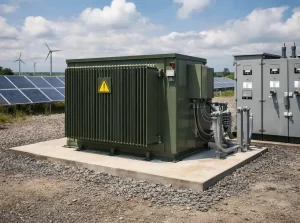
- Step-up transformers: Solar/wind gen-tie and genset/BESS hybrids—typical 0.48/0.6/0.69 kV → 15/25/35 kV.
How Turkish Transformer Supports U.S. Buyers
Turkish Transformer provides project-specific engineering, FAT/SAT support and full traceability. We supply distribution transformers, power transformers and step-up transformers with IEC-based or adapted ANSI/IEEE designs as requested.- Datasheets & drawings: Rapid pre-design and editable drawings.
- Loss-optimized designs: DOE-aligned low losses where applicable.
- Cooling & taps: ONAN/ONAF/ODAF, OCTC/OLTC.
- Logistics: Shipments to U.S. ports (EXW, FCA, CFR, DAP options).
FAQs
Is a step-up transformer the same as a power transformer? Not exactly—step-up describes a function. Depending on rating and voltages, a step-up unit may be engineered as a distribution or a power transformer. Which MV class should I choose for U.S. sites? Follow the interconnecting utility’s specification. The most common classes are 15/25/35 kV. Copper vs aluminum windings? Both meet ANSI/IEC when properly designed. Copper is more compact and heavier; aluminum is lighter and often more economical.